



- Home
- Baby [an error occurred while processing this directive]
- Toddler [an error occurred while processing this directive]
- Preschooler [an error occurred while processing this directive]
- Kindergartner [an error occurred while processing this directive]
- First Grader [an error occurred while processing this directive]
- Second & Third Grader [an error occurred while processing this directive]
- Articles
[an error occurred while processing this directive]
- Nursery Rhymes
- Sharing Poetry
- Author Focus: Jan Brett and Jane Yolen
- What Is Phonics, Anyway?
- What Not to Say to Emerging Readers
- Children's Choice
- Table Talk
- Tips for Summer Reading
- "Clicking" with Children: Computers and Young Children
- Book Clubs
- Car Talk
- Growing Up with a Learning Disability: A Child's Story
- Raising a Child with a Learning Disability: A Mother's Story
- Ways to Introduce Your Kids to Foreign Languages
- Learning Two Languages: Questions Parents Ask
- Reading to Two: A Double Challenge
- Qualities of a Good Classroom
- How to Create a Literate Home
- A Primer on Dyslexia
- Quick Tips [an error occurred while processing this directive]
- Sitemap
- About This Site
Home » Second & Third Graders »
Writing Milestones


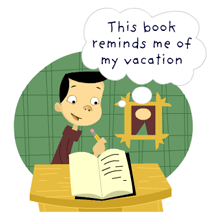
Your reader and writer uses writing as a way to deepen his understanding of literature. Through writing about what they read, second and third graders make new connections between what they read and their own experience. They can consider why a character acted the way he did or compare a particular book to another they have read before. Journal writing, book reports, book posters, short questions about reading, and research reports are all ways in which your child uses writing to deepen his understanding of what he reads.
Second and third graders develop greater ease in writing. For most, handwriting becomes automatic, so they can concentrate more on the content of their writing rather than on the mechanics. In addition, typical second and third graders are able to generate ideas for stories or journal entries with relative ease. The knowledge of story structures they have accumulated through years of being read to will help them to plan and write stories. By the end of third grade, most children are able to write lengthy stories, reports, and answers to questions.
Readers and writers learn that writing is actually a process that involves many steps. It starts with coming up with an idea and organizing thoughts around the idea. Then writers write a draft, use feedback to revise the draft, and edit for spelling and punctuation. With teacher and parent guidance and support, second- and third-graders can use all of these steps in their own writing.
By the end of third grade, most readers and writers know the correct spellings of many words. They may still use invented spellings on some complex, unfamiliar words, however. By the end of third grade, most children know when they have misspelled a word. They can either correct it themselves or consult a dictionary or an adult.
With support, readers and writers can revise and edit their work. They can use teacher and parent feedback to add more detail, clarify parts of their writing that are confusing, or choose more descriptive words in their writing. With the support of a teacher or parent, they can also apply what they know about spelling and punctuation to edit their writing. They do not yet know all the rules of punctuation, however, so even most third graders will need help when editing.
Encouraging Your Second & Third Grader
- Collect and display your reader and writer's work to help your child feel proud of himself. Many second- and third-graders write a lot. Set aside time to read their work and find ways of displaying and collecting their work. You can display work with magnets on the refrigerator and purchase a large plastic box in which to save your child's work. Collecting and displaying his words shows your child that what he writes is important to you.
- Share your child's work with family members to show her that her words are important. When your child writes a story or poem, offer her the chance to read it to Dad or to call Grandma and read it over the phone. Also help your child turn her words into books complete with illustrations that you can copy and send to family members as a gift. When you encourage your child to share her writing, you are demonstrating that you are proud of her and that her words and ideas are important to you.
- With support, readers and writers can revise and edit their work. They can use teacher and parent feedback to add more detail, clarify parts of their writing that are confusing, or choose more descriptive words in their writing. With the support of a teacher or parent, they can also apply what they know about spelling and punctuation to edit their writing. They do not yet know all the rules of punctuation, however, so even most third-graders will need help when editing.
- Encourage your child to fix errors herself. If your child is editing her writing, see if she can first find and fix some of her mistakes by herself. Typical second- and third-graders are not yet able to find and fix all of their mistakes, so after your child tries herself, it's OK to help her out.
- Encourage your child to spell common words correctly. Spelling common words, such as "the," "they," and "another" is important. Since these are the words your child uses most often in his writing, writing them incorrectly over and over again will simply help your child to remember an incorrect spelling. If your child often spells these little words incorrectly, you might make a list that he can refer to in his work so that he does not continue to misspell them.