



- Home
- Baby [an error occurred while processing this directive]
- Toddler [an error occurred while processing this directive]
- Preschooler [an error occurred while processing this directive]
- Kindergartner [an error occurred while processing this directive]
- First Grader [an error occurred while processing this directive]
- Second & Third Grader [an error occurred while processing this directive]
- Articles
[an error occurred while processing this directive]
- Nursery Rhymes
- Sharing Poetry
- Author Focus: Jan Brett and Jane Yolen
- What Is Phonics, Anyway?
- What Not to Say to Emerging Readers
- Children's Choice
- Table Talk
- Tips for Summer Reading
- "Clicking" with Children: Computers and Young Children
- Book Clubs
- Car Talk
- Growing Up with a Learning Disability: A Child's Story
- Raising a Child with a Learning Disability: A Mother's Story
- Ways to Introduce Your Kids to Foreign Languages
- Learning Two Languages: Questions Parents Ask
- Reading to Two: A Double Challenge
- Qualities of a Good Classroom
- How to Create a Literate Home
- A Primer on Dyslexia
- Quick Tips [an error occurred while processing this directive]
- Sitemap
- About This Site
Home » Second & Third Graders »
Reading Milestones


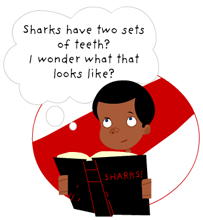
At this stage, children make meaning when reading by relating new information to what they already know. For instance, when reading an informational book about sharks, a child may try to picture the sharks he's seen in books and in the aquarium to help him understand a new piece of information -- that sharks actually have two sets of teeth. Children who have been read to a lot and who have had many opportunities to discuss ideas with their parents usually have a lot of knowledge about many topics. This background knowledge helps them to understand what they read.
Your second or third grader still uses "decoding" skills to sound out some words. Most children at this age recognize many words by sight, and this helps them be fluent readers. At the same time, all second and third graders still need to have the "decoding" skills necessary for sounding out the long, unfamiliar words they encounter in books. They also use these decoding skills to help them spell words.
Most second and third graders are becoming smoother, more efficient, more fluent readers. They begin to read faster, to read in meaningful phrases as opposed to word-by-word, and to read with greater expression. Their reading begins to resemble normal speech. Becoming a fluent reader is important because fluent readers tend to read more on their own and tend to understand more of what they read.
Reading a lot independently helps your second or third grader become fluent. When they read on their own, children not only increase their reading fluency, but they learn new vocabulary words, learn about different ways of telling stories and presenting information, and gain exposure to new concepts and information.
Readers and writers develop different strategies for reading fiction and nonfiction. Second and third graders learn that nonfiction text has a different structure from fiction. Nonfiction is also often more difficult to comprehend because it presents so many new facts and ideas. To help them understand nonfiction text, children learn specific strategies in school such as previewing the table of contents, the chapter headings, and the words in bold letters. They also learn to slow their reading pace if they need to and to read the captions below pictures in the text to help them.
There is a wide range of reading levels in second and third grade. Even among children who are not experiencing difficulty in reading, there is a wide range of reading abilities at this age. Some children will read books typical of their age, while others will be able to read books above their grade level. Children who are still struggling to read fluently in third grade may need extra help or some testing to pinpoint the source of the difficulty.
Encouraging Your Second & Third Grader
- Make sure your child chooses appropriate books to read by herself. For independent reading, children should be encouraged to read books that they can read fluently, or smoothly, and can understand well by themselves. A good way to tell if a book is at an appropriate level for your child is to listen to her reading a full page aloud. If she reads smoothly, makes no errors or just a couple of errors in reading the words, and can tell you about what she read, then the book is probably at a "just right" level for her. If her reading sounds choppy, she struggles to read words, or she does not understand what she has read, try an easier book.<
- Help your child develop an independent reading routine that will last a lifetime. Many second- and third-grade teachers make 20 to 30 minutes of independent reading a regular part of homework because it is important for children's reading development. If your child's teacher requires quiet reading as homework, help your child "budget" his time and figure out when he will complete it. Many children enjoy doing their free reading at a particular time and in a special spot in the house, whether it is on their bed or in the living room. If your child's teacher does not require independent reading, you might make it an expectation in your house.
- Help your child discover the resources available in your local library. When children at this age visit the library regularly, they get valuable assistance in finding new books to read. They also begin to see libraries as a source of information about topics that interest them. They may also even learn some specific library skills, such as how to look up a title on a computerized catalog.
- Show your child that you are a reader by reading yourself. When children see that their parents choose to read, they are more likely to value and enjoy reading themselves. One way busy parents can accomplish this goal is to read at the same time their children read as part of their homework. Whether you read the newspaper, a good novel, a magazine, or some papers for work, just reading alongside your child will encourage her to keep on reading.
- Listen to your child read to help him develop fluency. Children become fluent readers through lots and lots of practice. Make it a point to listen to your child read to you every so often. If your child makes a mistake when reading, encourage him to try and fix it himself by asking, "Did that make sense?" or "Should you reread that part?" To help your child read with greater expression and fluency, try reading and rereading plays and poetry together.<