



- Home
- Baby [an error occurred while processing this directive]
- Toddler [an error occurred while processing this directive]
- Preschooler [an error occurred while processing this directive]
- Kindergartner [an error occurred while processing this directive]
- First Grader [an error occurred while processing this directive]
- Second & Third Grader [an error occurred while processing this directive]
- Articles
[an error occurred while processing this directive]
- Nursery Rhymes
- Sharing Poetry
- Author Focus: Jan Brett and Jane Yolen
- What Is Phonics, Anyway?
- What Not to Say to Emerging Readers
- Children's Choice
- Table Talk
- Tips for Summer Reading
- "Clicking" with Children: Computers and Young Children
- Book Clubs
- Car Talk
- Growing Up with a Learning Disability: A Child's Story
- Raising a Child with a Learning Disability: A Mother's Story
- Ways to Introduce Your Kids to Foreign Languages
- Learning Two Languages: Questions Parents Ask
- Reading to Two: A Double Challenge
- Qualities of a Good Classroom
- How to Create a Literate Home
- A Primer on Dyslexia
- Quick Tips [an error occurred while processing this directive]
- Sitemap
- About This Site
Home » Second & Third Graders »
Talking Milestones


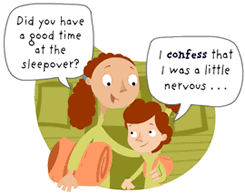
Second and third graders choose their words carefully. They know many words for a given concept and can choose the most appropriate word to use in a given context. For example, your reader and writer may know many words to express the concept of "said," including "whispered," "screamed," "confessed," and "blurted out." Instead of simply using "said," she will be able to select the word that most precisely expresses her meaning. Knowing many words for a single concept helps children not only to understand what they read, but to write stories using precise, descriptive language.
Your reader and writer can discuss implied meanings in the books he reads. Second and third graders can discuss the books they read at a deeper level than ever before. They can make logical inferences, putting together pieces of information to understand a message that is not explicitly stated in a book. They are also able to offer an opinion about the writer's craft by describing what words or parts of the book they liked. In discussions, they can back up their ideas by referring to particular parts of the story that support their thinking.
Your reader and writer can tell sophisticated stories about real and imagined events. Being able to tell complete stories and use all story elements when talking helps children to understand the books they read and to write good stories themselves. Second and third graders can spin tales that contain all the ingredients of a good story: characters, setting, events that lead to a conflict, a clear central conflict, and a resolution to the conflict. They may even include dialogue and complex character descriptions.
Your reader and writer can use language to collaborate with others. Second and third graders are able to ask questions to clarify ("How many facts do we need to collect?") and to offer suggestions ("Let's try making our model out of clay and wire."). They use language to organize ("Who wants to be the note taker?"), to agree ("That's a great idea!"), and to disagree politely ("I'm not sure your idea will work."). Being able to use language to collaborate helps children to learn more in groups.
Your second or third grader can give talks to the class. Whether giving a "book talk" about a favorite book, reporting on a small group's research about blue whales, or acting out a favorite book in a "readers theater" presentation, children at this age can demonstrate what they know by speaking to the class. Most children will need to prepare for an oral presentation in advance, however, by rehearsing what they want to say.
Encouraging Your Second & Third Grader
- Talk to your child about the books you read by yourself. Simply mentioning books you have read, information and news you found in the newspaper, or a great recipe you read in a magazine will help your child to know that you value reading. Many children enjoy hearing about the books that their parents read when they were children and get excited when they discover that they are reading some of the same books today.
- Talk about books you and your child read together to develop an appreciation for literature. When you read aloud to your child, make sure to discuss what you have read. Asking older children questions that encourage them to read beyond the plot helps them to develop important thinking skills. Instead of asking, "What happened?" try asking, "Why do you think the author used that word?", "What part of the story made you think that the dog would be safe in the end?", or "What makes him a character you like?"
- Form a parent-child bookclub. Get together with some other parents and their children on a regular basis, pick a book to read between sessions, and come prepared to discuss the book. Children's understanding of books can be improved through discussion with peers and adults. They get the opportunity to hear others' opinions and perhaps change their own thinking through discussion. Shireen Dodson's The Mother-Daughter Book Club is a good resource for how to go about setting up your own parent-child bookclub.
- Help your child develop good homework habits. You can help your child with his homework by making sure that he has a clear, quiet space in which to work and the necessary supplies, such as pencils and paper. You can also help your child budget his time by setting a consistent time for homework. An ideal homework time for second- and third-graders is after an after-school break and snack, but before they get too tired.
- Help your child with homework, but don't do it for her. Most teachers assign homework so they can see what children are able to do independently. Encourage your child to do her own work, but feel free to answer questions and clarify directions if need be. If you think you may be giving your child too much help, or if your child becomes frustrated easily, talk with your child's teacher.