



- Home
- Baby [an error occurred while processing this directive]
- Toddler [an error occurred while processing this directive]
- Preschooler [an error occurred while processing this directive]
- Kindergartner [an error occurred while processing this directive]
- First Grader [an error occurred while processing this directive]
- Second & Third Grader [an error occurred while processing this directive]
- Articles
[an error occurred while processing this directive]
- Nursery Rhymes
- Sharing Poetry
- Author Focus: Jan Brett and Jane Yolen
- What Is Phonics, Anyway?
- What Not to Say to Emerging Readers
- Children's Choice
- Table Talk
- Tips for Summer Reading
- "Clicking" with Children: Computers and Young Children
- Book Clubs
- Car Talk
- Growing Up with a Learning Disability: A Child's Story
- Raising a Child with a Learning Disability: A Mother's Story
- Ways to Introduce Your Kids to Foreign Languages
- Learning Two Languages: Questions Parents Ask
- Reading to Two: A Double Challenge
- Qualities of a Good Classroom
- How to Create a Literate Home
- A Primer on Dyslexia
- Quick Tips [an error occurred while processing this directive]
- Sitemap
- About This Site
Home » Preschooler »
Writing Milestones


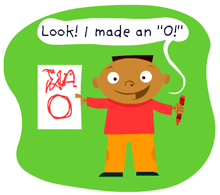
Your young child may begin to make real letters. These first "real" letters often occur by accident during scribbling and then are labeled by your child—"Look, I made an 'O'!" Some 4-year-olds may also begin writing their names. Displaying these first written letters on the refrigerator or door to your child's room clearly signals that this is a real accomplishment and that you and he should feel proud.
Your young child may request help in learning to write letters. As she begins to observe that writing is an important activity for adults, your child may want to learn "real" writing herself. Young children love to learn how to form the letters of their own names and of other "important" and frequently used words such as "Mom," "love," and "to."
Your young child may begin to show interest in what adults write. As your child watches you writing lists, letters, and forms, he may want to do the same thing. You can support his writing (pretend or real) by having a variety of materials readily available (pens, pencils, crayons, notepads, plain paper, colored paper, etc.). Young children develop confidence in writing when they are included in real writing activities. For example, many preschoolers are thrilled when adults suggest that they help write the grocery list or a thank-you note.
Your young child may become interested in typing or using the computer. This is especially true in households and settings where adults regularly use computers or typewriters. The amount of concentration and control over hand muscles that is required for computer and keyboard use is considerable and develops at different rates, so adult support is important.
Encouraging Your Preschooler
- Show your child the many ways you use writing every day. Call attention to the notes, lists, forms, and letters that you create on a daily basis. When young children have the opportunity to watch adults use writing in their everyday lives, it demonstrates the importance of the written word.
- Surround your child with signs. Seeing printed words around the house helps your child understand that there is a connection between spoken language and written language. You can label objects in your child's room, such as "books" or "door." Making a sign for your child's bedroom door or a "mailbox" for special notes also draws your child's attention to the printed word.
- Spend time "writing" with your child. Provide a wide range of writing supplies--different types of paper, notepads, envelopes, pens, crayons, and markers. Make these supplies available regularly for your child's use and join in as she draws and writes. As parents and caregivers write with young children, they can also help them learn to form letters. While younger children are not able to form letters yet, they will still enjoy "scribble writing" in ways that mirror adult uses of writing.
- Write down what your child says about his drawings. As your child is drawing or coloring, record what he says. You can also prompt your child to "tell a story" about the pictures he creates, cuts out, or sees around him and write those down as well. Older children enjoy making their own books that combine pictures and writing (either their own writing or their words dictated to an adult). You can help "publish" your child's stories by typing them into a computer and printing them out for children to illustrate. Encourage your child to share stories with others by showing them and reading them aloud.