



- Home
- Baby [an error occurred while processing this directive]
- Toddler [an error occurred while processing this directive]
- Preschooler [an error occurred while processing this directive]
- Kindergartner [an error occurred while processing this directive]
- First Grader [an error occurred while processing this directive]
- Second & Third Grader [an error occurred while processing this directive]
- Articles
[an error occurred while processing this directive]
- Nursery Rhymes
- Sharing Poetry
- Author Focus: Jan Brett and Jane Yolen
- What Is Phonics, Anyway?
- What Not to Say to Emerging Readers
- Children's Choice
- Table Talk
- Tips for Summer Reading
- "Clicking" with Children: Computers and Young Children
- Book Clubs
- Car Talk
- Growing Up with a Learning Disability: A Child's Story
- Raising a Child with a Learning Disability: A Mother's Story
- Ways to Introduce Your Kids to Foreign Languages
- Learning Two Languages: Questions Parents Ask
- Reading to Two: A Double Challenge
- Qualities of a Good Classroom
- How to Create a Literate Home
- A Primer on Dyslexia
- Quick Tips [an error occurred while processing this directive]
- Sitemap
- About This Site
Home » Preschooler »
Listening Milestones


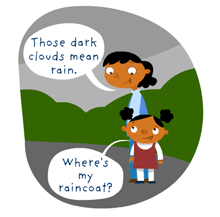
Your young child is able to understand more complicated language. Your preschooler's vocabulary expands rapidly, supporting her ability to talk about a wide-range of topics, from dinosaurs to doll houses to dark clouds in the sky. Your young child is also able to understand longer and more complex sentences, such as a set of directions. For example, young children are able to understand a parent or caregiver's request to "Put the puzzle away, find your coat, and meet me at the door."
Your young child may not always appear to be listening. Play is the work of young children, and they often take their work very seriously. As a result, sometimes your child may become so absorbed in his activities that he may not always respond to your requests.
From Reading Rockets
Young children enjoy listening to longer and more complex stories. Stories with interesting plots and compelling characters will capture your children's imagination. Books for this age group such as Swimmy, and Strega Nona are favorites. Young children delight in these fantastic tales.
Young children recognize and have fun with rhymes. Your young child will enjoy listening and playing with language by clapping along with a favorite song or laughing at a silly rhyme. Being able to hear the rhymes and rhythms in language is an important first step to developing "phonemic awareness," the ability to hear the sounds in language.
Encouraging Your Preschooler
- Talk about fascinating things you observe in everyday life. You can support your child's interests by providing books and activities that help him learn more about the world and how it works. For example, talk about what your child notices as he mixes blue and yellow paint--it's green! Then what happens when you mix red and yellow? Here comes orange! Later, read a book about color, such as Mouse Paint. The combination of hands-on activities, conversation, and reading is a powerful means of developing your child's interest in and understanding of concepts, such as colors, size, or weight.
- Ask genuine questions about your child's daily activities and experiences. Genuine questions, those to which you don't already know the answer, encourage genuine responses. Family mealtimes can be a great time for talking. This time allows young and old family members alike to "tell the story" of their days and all the interesting, puzzling, or even frustrating things that happen.
- Take family outings and talk about what you see. One way to support your child's interest in the world is to plan family outings around town or far from home. A walk to the local playground can become an opportunity to observe and discuss people, animals, or nature. A trip to the circus can become an opportunity for your child to learn unique vocabulary words such as "ringmaster," "aerial," and "fierce."
- Play rhyming games with your young child. Start with simple sounds like "at," "in," or "up" and think up as many words as you can that contain those sounds. Nonsense words are fun and perfectly acceptable. As your child masters the easy sounds, introduce harder sounds like "unky" (as in monkey, clunky, spunky, funky). Rhyming helps children become aware of the sounds of the language and lays a foundation for reading and writing development.