



- Home
- Baby [an error occurred while processing this directive]
- Toddler [an error occurred while processing this directive]
- Preschooler [an error occurred while processing this directive]
- Kindergartner [an error occurred while processing this directive]
- First Grader [an error occurred while processing this directive]
- Second & Third Grader [an error occurred while processing this directive]
- Articles
[an error occurred while processing this directive]
- Nursery Rhymes
- Sharing Poetry
- Author Focus: Jan Brett and Jane Yolen
- What Is Phonics, Anyway?
- What Not to Say to Emerging Readers
- Children's Choice
- Table Talk
- Tips for Summer Reading
- "Clicking" with Children: Computers and Young Children
- Book Clubs
- Car Talk
- Growing Up with a Learning Disability: A Child's Story
- Raising a Child with a Learning Disability: A Mother's Story
- Ways to Introduce Your Kids to Foreign Languages
- Learning Two Languages: Questions Parents Ask
- Reading to Two: A Double Challenge
- Qualities of a Good Classroom
- How to Create a Literate Home
- A Primer on Dyslexia
- Quick Tips [an error occurred while processing this directive]
- Sitemap
- About This Site
Home » First Grader »
Reading Milestones


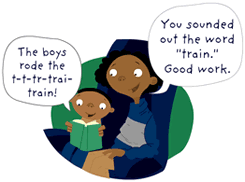
Your first grader is learning to "crack the code" of the written word. First graders learn phonics, the sounds of all letters and letter combinations. They apply phonics knowledge to figuring out or "decoding" words that they do not know by sight. Learning how to crack the code of reading also helps your first grader spell words he wants to use in his writing.
First graders know many words by sight. At the end of first grade, children typically know at least 150 "sight words," or common words, such as "the" and "no," that they recognize with ease. They learn sight words through repeated exposure in reading and by using these words over and over again in their own writing. When a first grader has a strong store of sight words, she can use her "known words" to help her figure out new words. For example, she can use "in" to help her figure out "chin" and "thin."
First graders can read simple books smoothly, but generally read word-by-word. By the end of the year, the typical first grader can read simple books such as Eat Your Peas, Louise! or Little Bear accurately, by identifying all the words correctly. Most first graders read word-by-word instead of in phrases, and they read fairly slowly, especially if they are reading a book for the first time. They become smoother readers by reading the same books over and over again. Although some first graders read to themselves, it is easier for most to read aloud. When your first grader reads aloud, he can hear himself as he tries to decode new words.
First graders can detect their reading mistakes. The typical first grader knows when he has made a reading error when the story suddenly does not make sense. While your first grader cannot correct all the errors she makes in reading, she is beginning to learn some strategies to "fix" her mistakes. Common strategies include rereading lines of a book to try it again, looking for a known word within a new word, and asking a friend or grown-up when she can't figure it out.
Encouraging Your First Grader
- Encourage your child to read aloud a little every day. Beginning readers need to practice, and most find it easier to read aloud. Set aside a special time to read to your child and save a few minutes for your child to read to you each day. Some first graders enjoy reading books to their siblings as well as to their parents. Others may enjoy making a tape recording of themselves reading aloud.
- Make sure that your child reads books at a "comfortable" level. Reading books that are too difficult is often frustrating, especially for beginning readers. Books that are appropriate for home reading are books that your child can read with little help from an adult. Check out our book lists for age-appropriate suggestions. Also ask your child's teacher or your local librarian to offer recommendations based on your child's interests and the types of books she now enjoys.
- Rereading books helps beginners become more fluent readers. First graders love reading books over and over again. If your child has read you a book, he may be motivated to read the same book to another family member. Rather than encouraging your child to pick up new books all the time, encourage him instead to reread books on which he is an "expert." Rereading will help your child develop reading fluency, or the ability to read smoothly, with expression, and at a reasonable pace.
- Encourage your child to correct her own errors by asking questions. When your child misreads a word, you might ask, "Did that make sense?" or "Does that sound right?" Then encourage her to reread a word or sentence. Of course, if your child can't figure out a word and is becoming frustrated, simply read the word for her. If she makes an error that does not change the meaning of the book, you need not do anything. These kinds of errors show that she is reading for meaning.