



- Home
- Baby [an error occurred while processing this directive]
- Toddler [an error occurred while processing this directive]
- Preschooler [an error occurred while processing this directive]
- Kindergartner [an error occurred while processing this directive]
- First Grader [an error occurred while processing this directive]
- Second & Third Grader [an error occurred while processing this directive]
- Articles
[an error occurred while processing this directive]
- Nursery Rhymes
- Sharing Poetry
- Author Focus: Jan Brett and Jane Yolen
- What Is Phonics, Anyway?
- What Not to Say to Emerging Readers
- Children's Choice
- Table Talk
- Tips for Summer Reading
- "Clicking" with Children: Computers and Young Children
- Book Clubs
- Car Talk
- Growing Up with a Learning Disability: A Child's Story
- Raising a Child with a Learning Disability: A Mother's Story
- Ways to Introduce Your Kids to Foreign Languages
- Learning Two Languages: Questions Parents Ask
- Reading to Two: A Double Challenge
- Qualities of a Good Classroom
- How to Create a Literate Home
- A Primer on Dyslexia
- Quick Tips [an error occurred while processing this directive]
- Sitemap
- About This Site
Home » Baby »
Talking Milestones


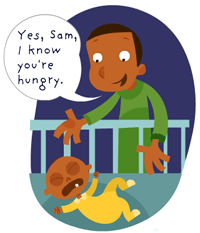
BIRTH TO 6 MONTHS OLD
Crying is your baby's first way of communicating with others. Your baby cries because she wants to be held, fed, or changed. A quick response reassures your baby that someone is there. Responding to your baby's cries is important because it helps her trust that you will meet her needs, and this is the beginning of a back-and-forth communication between you and your baby. Your 1-to 2-month-old baby will begin to communicate in new ways. She will show her delight by cooing, and she will be more likely to coo back when you respond to her. Towards the end of this period, babies like to experiment with sounds, as they blow bubbles and make "raspberries."
6 TO 12 MONTHS OLD
Babies begin to communicate by babbling. At first, "babababa" and "mamama" may not refer to anything specific. When you make a connection between your baby's babbling and objects or people of interest to him, he may learn a babble-word or two. Your baby may use "baba" to refer to "blankie" or "bottle," and he may also begin to jabber in a way that resembles real speech. By jabbering, babies practice the rhythm, sounds, and flow of their language.
12 TO 18 MONTHS OLD
During this period, your baby goes from having a couple of babble-words to a speaking vocabulary of about 20 words. She won't necessarily pronounce those words correctly because the small muscles that support her mouth and lips are still developing. Many babies will speak one word at a time, but often mean whole sentences by these words. For example, a baby who says, "Mo" may mean "I want some more milk."
Encouraging Your Baby
- Play games to teach your baby new words. Babies love to connect with parents through games, and parents can teach babies new words though games. Make up a game about body parts, asking your baby, "Where is Amy's nose?"; "Where is Mommy's nose?"; "Where is Amy's tummy?"; "Where is your foot?" Some babies will even try to trick parents by pointing to their nose when asked for their tummies and laughing.
- Sing songs with your baby. Singing is a form of play, especially if you sing songs with hand motions. Singing songs like The Wheels on the Bus or Twinkle, Twinkle, Little Star is a way to help your baby learn the patterns and intonation of language. Rhyming songs help your baby hear small differences in sounds, a skill he will need when he learns to read. You will be singing solo for awhile, but your baby will begin to chime in with words or hand actions when he is ready.
- When your baby plays with toys, talk to him about what he is doing. By saying, "That's a big truck!" and "That cat is sleeping!" you are teaching your baby new words. Asking your baby questions such as, "Where's the green truck?" while he plays will help him to practice using new words and ideas.
- Don't worry about correcting your baby's pronunciation, grammar, or choice of words. Instead, provide a positive example through the way you speak to your baby. If you use correct grammar and speech in responding to your baby, you are doing the very thing children need to develop language.