



- Home
- Baby [an error occurred while processing this directive]
- Toddler [an error occurred while processing this directive]
- Preschooler [an error occurred while processing this directive]
- Kindergartner [an error occurred while processing this directive]
- First Grader [an error occurred while processing this directive]
- Second & Third Grader [an error occurred while processing this directive]
- Articles
[an error occurred while processing this directive]
- Nursery Rhymes
- Sharing Poetry
- Author Focus: Jan Brett and Jane Yolen
- What Is Phonics, Anyway?
- What Not to Say to Emerging Readers
- Children's Choice
- Table Talk
- Tips for Summer Reading
- "Clicking" with Children: Computers and Young Children
- Book Clubs
- Car Talk
- Growing Up with a Learning Disability: A Child's Story
- Raising a Child with a Learning Disability: A Mother's Story
- Ways to Introduce Your Kids to Foreign Languages
- Learning Two Languages: Questions Parents Ask
- Reading to Two: A Double Challenge
- Qualities of a Good Classroom
- How to Create a Literate Home
- A Primer on Dyslexia
- Quick Tips [an error occurred while processing this directive]
- Sitemap
- About This Site
Home » Preschooler »
Talking Milestones


Your young child is able to participate in longer and more focused conversations. Many preschoolers become "big talkers." Their vocabularies increase as they learn and understand more words. Whether talking about a book she read, the equipment she saw at a construction site, or what she wants to do tomorrow at the park, your preschooler's talk is typically more "on topic" than during her toddler years. Some young children seem to talk in paragraphs, not just sentences. Others prefer to observe the world rather than talk about it.
Young children often "overapply" rules of language. Because they are still learning how language works, children may incorrectly apply a rule they have learned. For example, your child may apply the "-ed" to all verbs, saying, "We wented to the store" or "We goed to the store." These instances indicate that he is learning the rules of language.
Young children begin to narrate their actions with words. Parents and caregivers may hear preschoolers "thinking out loud." Children may talk out loud as they solve problems, control their behavior, and engage in pretend play. This is an important shift in your young child's thinking and language development, signaling an emerging ability to plan actions and reflect on them as they are carried out.
Young children learn to be creative users of language. Your child may make up her own words or names for things, especially favorite animals or people. For example, her stuffed wooly mammoth may become "mammly," or a pink dinosaur, "pinkety." Sometimes these creative uses can be funny, other times confusing, sometimes incomprehensible.
Young children learn the power of their words. Just as your young child becomes aware of the power he has to make things happen in the world, he is also discovering the power of words. It is normal for children to test out this power occasionally through insults or other forms of verbal aggression. These occasions, although not always welcomed by parents and caregivers, do provide teachable moments that adults can use to talk about the impact of words on others.
Encouraging Your Preschooler
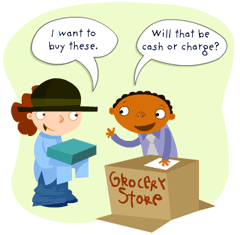
- Participate in pretend play with your child. Many children are natural pretenders and move easily between the worlds of fantasy and reality. They easily incorporate other children and a variety of props, such as a doctor's black bag, or a cash register and play money, into their ongoing play. When you join in, take your cues from your child and try not to take control of the situation. If your child is planning a surprise birthday party, you can be a guest and ask, "Can I help you with anything before the other guests arrive?" or "Where would you like me to set up the table?"
- Turn everyday activities and chores into opportunities for pretending. Play helps young children develop skills that are fundamental to reading by stimulating language development and the creative use of words. As children pretend, they also acquire an understanding of characters, the structure of stories, and point of view. You can help. For example, at the grocery store, you might suggest playing "detective" and find shoppers with particular items in their carts or find labels that contain the first letter of your child's name.
- As you read together, ask your child questions about the story. Helping your child link what is in the story to her own life or ideas promotes her understanding of stories. You can help your child make these important links by asking questions such as, "Does this grandma in the story remind you of Nanna?" or "What do you think it feels like to be able to fly?"
- Some young children need more support from adults to help them pretend. If your child needs help playing make-believe, you can show her how to pretend by using objects such as dolls or action figures. You can also participate in a pretend scenario or suggest roles for your child ("I need someone to ring up my groceries. Do you want to do that?"). As children become more experienced "players," parents can gradually lessen their participation.
- Provide corrections to your child's grammar indirectly. For example, if your child states that she "goed to the store with Daddy", you can provide a subtle correction by echoing her statement, "Oh, you went to the store with Daddy?". This models for your child the correct form of the word and shows that you are paying attention to the content of her language as well as the form.