



- Home
- Baby [an error occurred while processing this directive]
- Toddler [an error occurred while processing this directive]
- Preschooler [an error occurred while processing this directive]
- Kindergartner [an error occurred while processing this directive]
- First Grader [an error occurred while processing this directive]
- Second & Third Grader [an error occurred while processing this directive]
- Articles
[an error occurred while processing this directive]
- Nursery Rhymes
- Sharing Poetry
- Author Focus: Jan Brett and Jane Yolen
- What Is Phonics, Anyway?
- What Not to Say to Emerging Readers
- Children's Choice
- Table Talk
- Tips for Summer Reading
- "Clicking" with Children: Computers and Young Children
- Book Clubs
- Car Talk
- Growing Up with a Learning Disability: A Child's Story
- Raising a Child with a Learning Disability: A Mother's Story
- Ways to Introduce Your Kids to Foreign Languages
- Learning Two Languages: Questions Parents Ask
- Reading to Two: A Double Challenge
- Qualities of a Good Classroom
- How to Create a Literate Home
- A Primer on Dyslexia
- Quick Tips [an error occurred while processing this directive]
- Sitemap
- About This Site
Home » First Grader »
Talking Milestones


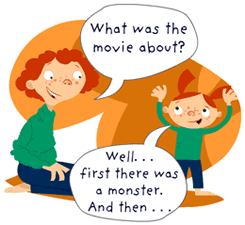
When talking about her experiences, your first grader includes many details--not just the most important points. A first grader's narrative typically includes not only information about what happened, but information about the setting, the people involved, what the people said, and what she thought about the event. First graders tend to include many details in their stories, and they are not yet able to summarize a story.
From TeacherSource
The average first grader knows thousands of words. Your child has learned new words in many different ways--through talking with you, through hearing books read aloud, and through new experiences at home and in school. Having a strong vocabulary is important for learning to read. After all, the more words your child knows, the more words he will be able to recognize in print.
First graders love to talk about the books they read and listen to. Discussion helps first graders understand the meaning of books they read and listen to. They can talk about the plot, or what happened in a story, as well as many ideas that are not directly stated in the book. Your first grader can relate a story to her own experiences, be a critical reader by telling what she liked or disliked about the story, and make inferences by imagining what might happen next if the book had a sequel.
First graders' speaking is more rich and complex than their writing. The typical first grader uses a small fraction of the words he knows when he writes. It is common for a first grader to speak at length about dinosaurs or tell about a family outing in great detail. He may only be able to write down a sentence or even a list of words about the topic, however. Your child's writing may not rival his speaking for years to come.
Encouraging Your First Grader
- Tell stories about real and imaginary events to increase comprehension. Take turns with your child talking about the day--what happened, what was surprising, what was funny. Also try making up stories together and even writing them down. Whether you're in the car, on the bus, or getting ready for bed, ask your child to choose some favorite characters for the story. Start off by telling the story yourself, have your child take a turn, and then alternate. When you tell stories together, you help your child learn what elements make up a good story, which will help his reading comprehension and writing.
- Encourage your child to ask questions about words. Keeping up with a first grader's questions may be trying for parents, but asking about words is an important habit to develop. Simply saying, "I'm glad you asked that," or "That's a good question!" when your child asks about a word will keep him questioning when he comes across new words. If you hear an unfamiliar word, think aloud about its meaning or consult a dictionary. Your curiosity demonstrates that even grown-ups wonder about words.
- Talk about challenging vocabulary words, concepts, and figures of speech. This will help broaden your child's vocabulary, deepen her understanding of all the concepts words represent, and help her to understand better what she is reading. However, not all words require the same level of discussion. Sometimes children simply learn labels, or names for concepts they already understand. At other times, they learn words that represent new ideas and therefore benefit from deeper discussion. For example, when your child learns the word "gravity," she will need a lot of discussion and many examples in order to understand this very complex idea. The word "poodle" may need less discussion--just a quick mention, such as, "That's a kind of dog."
- Play games with language to increase vocabulary, develop problem-solving skills, and practice letter sounds. Try playing "Categories," a simple game in which you select a category, such as "clothing" or "things that start with the letter B." Then, invite your child to take turns with you naming items that belong in the category. Your first grader may also enjoy and benefit from playing board games that involve letters and problem-solving, such as a children's version of Scrabble, Boggle, or Clue, Jr.