



- Home
- Baby [an error occurred while processing this directive]
- Toddler [an error occurred while processing this directive]
- Preschooler [an error occurred while processing this directive]
- Kindergartner [an error occurred while processing this directive]
- First Grader [an error occurred while processing this directive]
- Second & Third Grader [an error occurred while processing this directive]
- Articles
[an error occurred while processing this directive]
- Nursery Rhymes
- Sharing Poetry
- Author Focus: Jan Brett and Jane Yolen
- What Is Phonics, Anyway?
- What Not to Say to Emerging Readers
- Children's Choice
- Table Talk
- Tips for Summer Reading
- "Clicking" with Children: Computers and Young Children
- Book Clubs
- Car Talk
- Growing Up with a Learning Disability: A Child's Story
- Raising a Child with a Learning Disability: A Mother's Story
- Ways to Introduce Your Kids to Foreign Languages
- Learning Two Languages: Questions Parents Ask
- Reading to Two: A Double Challenge
- Qualities of a Good Classroom
- How to Create a Literate Home
- A Primer on Dyslexia
- Quick Tips [an error occurred while processing this directive]
- Sitemap
- About This Site
Home » Kindergartner »
Talking Milestones


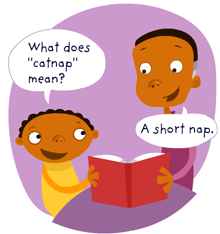
Kindergarten is a time of enormous vocabulary growth. Experts estimate that kindergartners use a vocabulary of several thousand words in speaking. They learn new words by hearing them in stories and having conversations with adults and children who have larger vocabularies than they do. They often ask questions about more complex words, like "catnap" or "harmony." Knowing the meanings of many words will help your child understand stories that are read aloud to him as well as those that he reads later independently.
Your kindergartner is able to tell a complete story about something that interests her. She is still refining her storytelling abilities, however, and she may end a story at its high point rather than drawing it to a conclusion. Kindergartners' stories often include ALL the details rather than a main point and a few important details. This developing ability to tell a good story is important for comprehension as well as for writing stories.
Your kindergartner can explain how to do simple tasks. Kindergartners love to explain how--whether it be how to make applesauce, how to make the letter "M," or how to brush their teeth. By the end of the fifth year, they can accurately give directions about how to do simple tasks, keeping the steps in order. Being able to put events in a logical sequence will help your child understand and eventually write stories.
Your kindergartner is developing an awareness of sounds and words. Kindergartners can recognize and make rhymes. They can list words that begin with the same sound, such as "bear," "bed," and "butter." They also begin to recognize that words can be taken apart into individual sounds. For example, they can separate "dog" into "d" and "og" and "cat" into "c," "a," and "t." These sound skills are important for learning phonics skills, the relationships between letters and sounds, and learning to read.
Your kindergartner is learning the rules of classroom conversation. Your kindergartner is learning to look at the speaker, to take turns talking, to signal understanding by nodding or agreeing, and to signal, through a raised hand, that he needs a chance to speak. He is also learning to use polite words, such as "please" and "excuse me." At this stage, however, he is just learning and may need many reminders to use these rules. Being able to follow these rules allows children to listen, to participate, and to benefit from the rich discussions that occur in classrooms.
Encouraging Your Kindergartner
- Ask your child about the past, present, and future. Provide your child with opportunities for using the past tense by asking her what happened at school or about a special event. Have her practice using the future tense by telling about a field trip or family outing that will happen over the next few days. Helping your child keep a calendar of events is a good way to stimulate these discussions.
- Talk about "What if?" Capitalize on your kindergartner's vivid imagination and extend your conversation with "What if?" You might ask your child, "What do you suppose our cat would say if he could talk?" or "What animal would you be if you could be any animal?" This kind of discussion helps your child practice grammatical constructions, helps him think about and discuss cause and effect relationships, and helps him make predictions. These thinking skills help children understand stories and information read aloud to them and will eventually help them to understand when they read independently.
- Ask your child for simple explanations and directions. Provide opportunities for your child to practice his budding directorial skills! Being able to put events in a logical sequence will help your child understand and eventually write stories.
- Play word games with sounds and letters. Word games build your kindergartner's awareness of similarities and differences among sounds, and this is important for learning how to read. Try finding rhymes for "eat" or thinking of all the foods you can that start with the letter "B." You can play a game in which you list items that a person likes. The twist is that people can only like items that begin with the same sound as their names. For example, say, "Sally likes to eat celery, salad, and cinnamon." Then ask, "What does Jennifer like to eat?" Variations to word play games are endless, and many families enjoy making up their own.
- Discuss conversational rules with your child. Some children become aware of rules “naturally”, while others may benefit from direct explanation. In addition to reminders about the conventions of politeness, children may need practice with conversational skills and turn taking. Being able to follow these rules allows children to listen, to participate, and to benefit from the rich discussions that occur in classrooms.