



- Home
- Baby [an error occurred while processing this directive]
- Toddler [an error occurred while processing this directive]
- Preschooler [an error occurred while processing this directive]
- Kindergartner [an error occurred while processing this directive]
- First Grader [an error occurred while processing this directive]
- Second & Third Grader [an error occurred while processing this directive]
- Articles
[an error occurred while processing this directive]
- Nursery Rhymes
- Sharing Poetry
- Author Focus: Jan Brett and Jane Yolen
- What Is Phonics, Anyway?
- What Not to Say to Emerging Readers
- Children's Choice
- Table Talk
- Tips for Summer Reading
- "Clicking" with Children: Computers and Young Children
- Book Clubs
- Car Talk
- Growing Up with a Learning Disability: A Child's Story
- Raising a Child with a Learning Disability: A Mother's Story
- Ways to Introduce Your Kids to Foreign Languages
- Learning Two Languages: Questions Parents Ask
- Reading to Two: A Double Challenge
- Qualities of a Good Classroom
- How to Create a Literate Home
- A Primer on Dyslexia
- Quick Tips [an error occurred while processing this directive]
- Sitemap
- About This Site
Home » Baby »
Writing Milestones


BIRTH TO 6 MONTHS OLD
Babies are just learning to use their hands. At first, your baby will not be able to grasp objects by himself, but he will awkwardly grasp a toy placed in his palm. Your 4-to 6-month-old baby can reach for and grasp things he wants. Babies will explore objects by putting them in their mouths.
6 TO 12 MONTHS OLD
Babies gain more control over their hands. At this age, your baby is able to pass objects from hand to hand and may enjoy ripping and pulling materials. She is able to pick up very small objects using her thumb and forefinger. Babies' hand movements become more precise, allowing them to feed themselves finger food and place rings on a post.
12 TO 18 MONTHS OLD
Babies have developed the hand skills necessary for grasping writing tools and making marks on paper. Only at the very end of infancy, at 17 or 18 months, will your baby begin to become interested in writing. You should not expect pictures or even "coloring," let alone letters, from your baby. By scribbling, your baby explores what he can do with crayons and paper and tries to imitate what he sees older children and parents do.
Encouraging Your Baby
- Chunky tools are easier for small hands. As your baby learns how to scribble, it is easier for the small muscles in his hands to grasp thicker writing tools. Markers, crayons, chalk, and paintbrushes are all available in special chunky "young child" versions that are ideal for beginners.
- Use washable materials to save on cleanup. When your baby is learning to scribble, she doesn't have a lot of control. Provide her with washable crayons, paints, and markers. A plastic smock or an old T-shirt can be used to protect her clothing, and a sheet of plastic or painting tarp can protect the floor. Talk to your baby about trying to keep marks on the intended writing or painting surface, but don't expect perfection.
- Use washable materials to save on cleanup. When your baby is learning to scribble, she doesn't have a lot of control. Provide her with washable crayons, paints, and markers. A plastic smock or an old T-shirt can be used to protect her clothing, and a sheet of plastic or painting tarp can protect the floor. Talk to your baby about trying to keep marks on the intended writing or painting surface, but don't expect perfection.
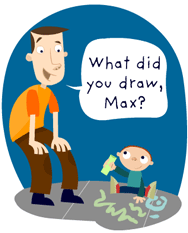
- Talk to your baby about her scribbles. Ask your baby, "What did you write?" or comment on the colors she used. By asking her questions about and commenting on her work, you help her to understand that her marks on paper represent an object or an idea. Express pride in your baby's work by offering specific comments, such as "You wrote a lot of letters!" or "What a big doggie you drew!"