



- Home
- Baby [an error occurred while processing this directive]
- Toddler [an error occurred while processing this directive]
- Preschooler [an error occurred while processing this directive]
- Kindergartner [an error occurred while processing this directive]
- First Grader [an error occurred while processing this directive]
- Second & Third Grader [an error occurred while processing this directive]
- Articles
[an error occurred while processing this directive]
- Nursery Rhymes
- Sharing Poetry
- Author Focus: Jan Brett and Jane Yolen
- What Is Phonics, Anyway?
- What Not to Say to Emerging Readers
- Children's Choice
- Table Talk
- Tips for Summer Reading
- "Clicking" with Children: Computers and Young Children
- Book Clubs
- Car Talk
- Growing Up with a Learning Disability: A Child's Story
- Raising a Child with a Learning Disability: A Mother's Story
- Ways to Introduce Your Kids to Foreign Languages
- Learning Two Languages: Questions Parents Ask
- Reading to Two: A Double Challenge
- Qualities of a Good Classroom
- How to Create a Literate Home
- A Primer on Dyslexia
- Quick Tips [an error occurred while processing this directive]
- Sitemap
- About This Site
Home » First Grader »
Writing Milestones


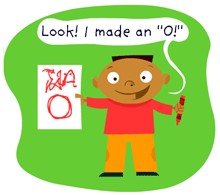
Your first grader can revise his writing. He may work over time on the same piece of writing and he can work on "revising" or "polishing" his writing. He might "revise" his work by adding more detail to the original piece, adding more to an illustration, or correcting a mistake that he has detected.
First graders use a combination of "invented" and correct spelling. "Invented spelling," or writing words the way they sound, is a way for children to practice breaking words into individual sounds and remembering what letter or letters make that sound. "Vacation" is "vakashun," and "canoe" is "knoo." First graders can also spell many common words the correct way, such as "the" and "said," words that follow familiar patterns, such as "big" and "pig," and simple word endings, such as "ing."
Your first grader writes many times a day for different purposes. First graders write to express thoughts and feelings in journals, write stories, and make lists of facts about topics of interest. They also write for different subject areas. Your first grader might use words and pictures to describe what she sees as her bean seed grows or to explain a solution for a math challenge. At this age, children also like to include writing in their play, and many choose to write stories, lists, cards, and other kinds of messages at home.
First graders use only some punctuation. Although they are exposed to punctuation through reading, first graders usually are not yet able to use it consistently and correctly in their own writing. They may try to use periods, quotation marks, and question marks, but they may use them in the incorrect places. After all, they are not yet sure of where sentences begin and end.
First graders use "story language" in their own writing. They may use phrases such as "Once upon a time" and "happily ever after." They may introduce dialogue with phrases like "The wolf cried." This shows that first graders already make connections between reading and writing. In addition to mimicking story language, many first graders enjoy using a favorite book character in their own writing. They may invent new tales about My Father's Dragon or create more adventures for Arthur.
Encouraging Your First Grader
- Find a way to include writing in your first grader's routines. Make a calendar on which he can record special events such as holidays, birthdays, and play dates with friends. You can also ask your child for help as you write the grocery list and work together to write down a story about real or imaginary events. Having your first grader write "thank you" cards for birthday presents or make labels for his shell collection are other great ways to encourage writing. When you make writing a part of each day, you help him to practice and become a better writer.
- Help your child keep a journal or diary to write down thoughts and feelings. Most first graders feel proud of their writing ability and like to have a special notebook or diary in which to write. You might ask your child to turn an inexpensive spiral notebook into a diary by decorating its cover. Larger paper works better for first graders, as children tend to write big until they gain better control of the small muscles in their hands. Keeping a journal encourages your child to write about the things he knows best: his own experiences.
- Encourage your child to write stories instead of focusing on correct spelling or punctuation. Parents can help young writers develop by emphasizing the fact that writing is a way to tell stories and share feelings, thoughts, and ideas. Help your child not to focus on using the correct punctuation or spelling words the correct way. Instead, encourage "invented spelling," sounding out words and writing words the way they sound. You might also make a one-page "dictionary" of words your child uses often in her writing so that she can refer to this list when she wants to spell a word.
- Don't stop your child from writing about topics or events more than once. Repeated stories about a particular topic or character are common at this age. Writing about one topic over and over again will help your child learn to perfect a particular story structure, style of writing, and the spellings of certain words. Help your child compile his work into a "chapter book" or into a series of little books
- Make a collection of your child's writing to instill a sense of pride. Whether you collect your child's writing in a simple box or in a scrapbook, you will enjoy looking at this collection in years to come. You will be able to see the enormous growth your child makes in a relatively short period of time.