



Home » Grade-by-Grade Learning »
Grade-by-Grade Learning: 4th Grade


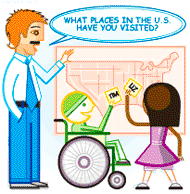
"Teachers invite children into the learning process by asking them to use their own knowledge and interests to approach more abstract concepts, such as maps. Students have to understand many challenging concepts to read a map: scale, proportion, abstraction, representation, geographic entities. The more children can find ways to connect real-world understandings to what they’re learning, the more successful they will be."
Diane Levin, Ph. D.
Professor of Education, Wheelock College. Author, Remote Control Childhood
The Basics
In fourth grade children take on new types of work and social experiences, and for some, these can be tough. Fourth graders may struggle to follow the many directions and long-range planning that their school assignments require. They have to collaborate with their peers on group projects, which can be stressful in the charged social dynamics that emerge in fourth grade. Students will probably have a textbook for each subject, as well as multiple folders, all of which can present organizational challenges (plus heavy backpacks). The work gets harder and they need to manage it more independently — that includes homework assignments in multiple subjects, as well as keeping track of those assignments and tasks.
Language & Literacy
Books, books, and more books fill the curriculum as fourth graders become sophisticated readers. They can use root words (words that are the basis for other words, such as "act" in "action"), context clues (looking for clues in the surrounding text and images in the story), and word endings to figure out new words. They’ll spend long periods of time reading and writing on their own. Teachers introduce genres such as myths and legends, fantasy and adventure. Fourth graders relate characters and other story elements to their own lives, and empathize with the characters most like them.
Fourth graders begin to use research tools, such as a dictionary, encyclopedia, library and the Internet, to gather information independently on a topic. Most importantly, they start to learn to organize this information into paragraphs, essays, projects, and presentations that help students synthesize their learning — although their work is appropriately far from "perfect." They develop a writing style where their personality comes through as well as skills to help them edit their work.
Math
Fourth graders read, write, compare, add, subtract, multiply, and divide with very large whole numbers. They do more equations with fractions and decimals and learn about prime numbers (numbers that can only be divided by themselves and 1). They solve problems about factors (one of two or more numbers that can be multiplied) and multiples (a number that can be divided exactly by a smaller number) and explore geometry formulas for determining perimeter and area, and for measuring angles. Fourth graders figure out conversion problems, such as determining the number of minutes in an hour, or ounces in a pound. They not only read graphs, tables, and charts but should be able to create them from data they’ve collected.
Science
Fourth graders begin to compare complex systems in a complex manner. This can mean looking at changes in the Earth over long periods of time, observing the water cycle, or understanding the interactions between organisms and their environment. Students work on projects that ask them to build hypotheses and make predictions. Science topics may include matter and its different states, forms of energy, and the solar system.
Social Studies
Fourth grade social studies typically moves from learning about the local community to the history of the students’ home state. Students will learn about the first people to live in the area, explore changes in state populations over time, and how different people and cultures have adapted to and influenced the state. They’ll learn to place major events in the state’s history in chronological order. Local and state government structure will be introduced, and students will learn about the government offices responsible for making, enforcing, and interpreting state laws.