



Home »
Try at Home
"The practice of art isn't to make a living. It's to make your soul grow."
—writer Kurt Vonnegut.
This section lists just a few ideas for creativity-enhancing projects to try at home. Because creativity involves unique self-expression, no list can possibly be complete. Instead, this information is intended to inspire you and your child to find ways to express your own creativity.
- Make a Collage
- Appreciate — or Make — a Quilt
- Arrange a Bouquet
- Play Board Games
- Make a Real Window Box
- Musical Mood Moves
- Make Musical Magic
- Puppets
- Garden Watching
- Safari
- Sky-Watching
- Visit an Art Museum
- Make a Reverse Mural
- Paint Watercolor Wings
Make a Collage
Let your child make his or her own shapes with paper, fabric or other material. Encourage your child to cut the shapes out independently, but be prepared to help when needed. Arrange them on a background.
This activity relates to Matisse Cut-Outs.
Appreciate —or Make — a Quilt
Quilts are blankets made of layers of cloth. What interests most people is the beautifully decorated top layer. Art quilts can be either pieced or whole cloth decorated by dyeing, painting or stitching, and crazy quilts are pieced in wild, varied patterns. But traditional American quilts are pieced in regular geometric patterns sewn into blocks.
Traditional designs vary not only in colors and fabrics, but also in how many times the basic block is repeated and how the blocks are oriented. To illustrate this for yourself and your child, try the following:
- Take two same-sized square pieces of paper. Crease them in half in both directions.
- Lay each flat and trace a circle on it, using the intersection of the creases as its center. For best results, make the same size circle on each paper.
- Use one color to color inside the circle on one sheet of paper, and the same color to color outside the circle on the other sheet of paper.
- Now cut the papers along the creases so you have eight squares with quarter circles in one corner of each.
- Experiment with rearranging them in fun patterns.
Below are some sketches of what your designs might look like and a possible way you could arrange the segments after you cut the papers along the creases.

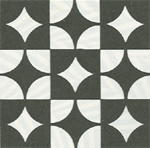
See if you can find the smallest repeating part of any quilt you come across.
Throughout the quilt's history, friends, family, and neighbors have worked together to produce breathtaking pieces of art. Faith Ringgold, a very accomplished quilter and children's author, beautifully depicts a quilting bee in her painting The Sunflower Quilting Bee at Arles.
Many groups use the collaborative energy of quilts to raise awareness or understanding of an issue. Parents may remember the AIDS quilt to which thousands of people contributed commemorative squares.
This activity relates to Mural, Matisse Cut-Outs, (because some quilts are also made by appliqué) and Kaleidoscope.
Arrange a Bouquet
Whether you pick flowers in a meadow or from your florist's refrigerator case, you can relax by arranging them into beautiful groups. Notice different petal and leaf shapes. Enjoy the beautiful colors, shapes and aromas of plants and flowers. You might want to explore the Japanese art of Ikebana.
This activity relates to Window Boxes and encourages the exploration of beauty found in Designer Butterflies.
Play Board Games
Mousetrap, Spirograph, and Fascination all use simple machines.
Encourage your child to play games that require strategic thinking to sharpen their problem-solving skills. Games that combine strategy and chance will keep their thinking flexible, encouraging openness to experiences and making the best of situations.
This activity relates to Marble Drop.
Make a Real Window Box
If you have limited ground space or want to decorate your home, you and your child could make a window box. These directions assume adult help every step of the way. They are adapted from Earth Child 2000: Earth Science for Young Children—Games, Stories, Activities and Experiments by Kathryn Sheehan and Mary Waidner, PhD. (ages 4 to 8).
- Let your child help you find or make a box that will fit on your windowsill. Make drainage holes on the bottom of the box (This is an adult task!). A box with "feet" to lift most of it off the sill will have even better drainage.
- Layer gravel or small stones along the bottom. Add compost or potting soil, leaving room for planting.
- Plant seeds, seedlings or whole plants. Cover seeds and/or roots with more compost or potting soil.
- Help your child move it to the windowsill. Secure it in place (many home improvement stores sell plastic window boxes and easy to use metal brackets).
- If your window is high, tape or wire sticks to old spoons and forks to make long handled gardening tools so your child can take care of the plants without have to lean out the window (though you still need to watch).
Perhaps your child could invent a watering or irrigation system for the window box.
This activity relates to Window Boxes and Plumbing Pro.
Musical Mood Moves
Put on different kinds of music and move your body to their different musical styles. What "mood" does the music express? How can you tell?
Or if you are with a few children, you could adapt a song about moods. For example, you could adapt the song "If You're Happy and You Know It" to instead take turns suggesting different moods and showing each of those, as in "If you're (happy/sad/surprised/scared/mad, etc.) and you know it, show it now."
This activity relates to Emoticons, Pentatonic Scales, and Uneven Bars.
Make Musical Magic
Take a Safari around your home to collect objects that you could use to make sounds. Can you use the same object differently to make different sounds? Can you create an orchestra with your found instruments?
You may have seen street performers making music on found objects like overturned plastic pails. In fact the beautiful sounds of the steel drum come from used oil drums.
This project relates to Pentatonic Scales.
Puppets
Use paper plates, markers, yarn, construction paper, and other common arts and crafts materials to create a puppet or set of puppets that display different emotions.
You could also make puppets out of old mateless socks, or smaller ones out of plastic spoons. Imagine your own possibilities.
Use your puppets to create a play!
This activity relates to Emoticons and Shadowcasting.
Garden Watching
It is sometimes said that the best pesticide is the gardener's shadow. Checking and tending your plants every day helps them stay healthy. You may know your garden very well from your routine checks, but it can be fun and informative to simply sit and observe your garden at a different time of day. A summer night is a magical time for the garden.
Another fascinating observation is just below the surface. Sometime when you've got a little of the ground open, sit and admire your "micro-herds," all those tiny insects and organisms working to aerate your soil and fertilize your plants.
And of course, gardeners get lots of their ideas from one another. Sit and enjoy someone else's garden. Perhaps you'll get ideas for attracting beautiful butterflies or hummingbirds to your place.
This activity relates to Window Boxes and Designer Butterflies.
Safari
Going on a safari helps your children acquire two ideas:
- Deciding first what to pay attention to helps you find more examples. Many parents will have had the experience of buying a car and suddenly seeing how many other drivers have the same make and model. Plus, if you first decide what you are going to look or listen for, you will both be looking for similar things.
- Keeping track of what you notice, by counting or making pictures, helps you appreciate it more. Decide how you want to track what you notice. Some children just love numbers and data. Others find that taking a photograph or drawing a picture of the items searched for makes the trip more enjoyable.
The next thing to decide is how you are going to travel. In addition to physical exercise, walking or biking provide a slowed-down way to notice more of your surroundings. Walking makes elaborate recording systems possible, whereas cyclists may just call out and tally their sightings.
A fun way to do a micro safari is to crawl the length of a long piece of yarn stretched out on soft safe ground such as a lawn.
Safari relates to Mural, Plumbing Pro, Marble Drop, and Window Boxes.
Symmetry Search, a variation on a safari, relates to Designer Butterflies and Kaleidoscope. Look around you to find "real life" examples of symmetry, such as the human body, oriental carpets, quilts, ladybugs, kaleidoscopes. Since Symmetry Search is a safari that searches for specific examples of an abstract concept, it is suitable for older children.
Sky-Watching
Babies enjoy strong color contrasts and when outside will look at tree leaves against the sky. Have you and your child lain down under trees and studied the silhouettes of their leaves? What could you see in the shapes of the sky peeking through them? What shapes could you find in the clouds?
Can you stargaze where you live? You may want to visit a planetarium if there is one nearby.
This activity relates to Stars and Matisse Cut-Outs.
Visit an Art Museum
Many museums offer an evening a week or an occasional holiday when admission is free or very inexpensive. Take your child to look at art. To avoid museum fatigue, check out the museum's Web site or call the museum's education department beforehand and make a plan of seven to ten works you and your child want to see. Your child may enjoy carrying a small notebook and colored pencils to draw some of the objects you visit.
You could also search the Web for online art museums.
This activity relates to Matisse Cut-Outs and Mural.
Make a Reverse Mural
This project is most fun with a small group of artists.
- Using a large piece of newsprint or butcher paper, take turns having each artist make two marks on the paper. The adult may want to go first to demonstrate. Be bold, swirl a line or curve across much of the paper.
- Then crease and cut the paper into as many segments as there are artists in your group.
- Turn the paper over and number or label the segments so that you can put them back in order at the end of the project.
- Hand out a segment to each artist. He or she can then decorate the already marked side of the paper.
- After everyone is done reassemble the mural.
Look at the mural and talk about what you notice. Are there any similarities or differences? Can you still see the continuous marks made when it was all one piece?
This project relates to the Mural activity.
Paint Watercolor Wings
Butterfly wings are symmetrical, basically the same on each side of the butterfly body. Use this activity as another way to explore how symmetry can be created by repetition.
Crease a piece of heavy paper in half. Take some watercolor paints and use droplets, brush strokes, layering, and color combinations to make a design on one half of the paper. Then fold the paper along the crease to transfer the design to the other half of the page. Explain that the design is symmetrical. You might even try holding a hand mirror next to the design to show how a mirrored reflection shows the same design that's on the other half of the page.
Another neat way to make symmetrical designs is by flattening coffee filters into circles and then re-folding them into the number of wedges you wish. Draw on the top wedge with fresh markers. When you open the folds, the marks should have permeated the layers and given you a symmetrical design.
This activity relates to Designer Butterflies and Kaleidoscope.


"The practice of art isn't to make a living. It's to make your soul grow."
—writer Kurt Vonnegut.
This section lists just a few ideas for creativity-enhancing projects to try at home. Because creativity involves unique self-expression, no list can possibly be complete. Instead, this information is intended to inspire you and your child to find ways to express your own creativity.
- Make a Collage
- Appreciate — or Make — a Quilt
- Arrange a Bouquet
- Play Board Games
- Make a Real Window Box
- Musical Mood Moves
- Make Musical Magic
- Puppets
- Garden Watching
- Safari
- Sky-Watching
- Visit an Art Museum
- Make a Reverse Mural
- Paint Watercolor Wings
Make a Collage
Let your child make his or her own shapes with paper, fabric or other material. Encourage your child to cut the shapes out independently, but be prepared to help when needed. Arrange them on a background.
This activity relates to Matisse Cut-Outs.
Appreciate —or Make — a Quilt
Quilts are blankets made of layers of cloth. What interests most people is the beautifully decorated top layer. Art quilts can be either pieced or whole cloth decorated by dyeing, painting or stitching, and crazy quilts are pieced in wild, varied patterns. But traditional American quilts are pieced in regular geometric patterns sewn into blocks.
Traditional designs vary not only in colors and fabrics, but also in how many times the basic block is repeated and how the blocks are oriented. To illustrate this for yourself and your child, try the following:
- Take two same-sized square pieces of paper. Crease them in half in both directions.
- Lay each flat and trace a circle on it, using the intersection of the creases as its center. For best results, make the same size circle on each paper.
- Use one color to color inside the circle on one sheet of paper, and the same color to color outside the circle on the other sheet of paper.
- Now cut the papers along the creases so you have eight squares with quarter circles in one corner of each.
- Experiment with rearranging them in fun patterns.
Below are some sketches of what your designs might look like and a possible way you could arrange the segments after you cut the papers along the creases.
See if you can find the smallest repeating part of any quilt you come across.
Throughout the quilt's history, friends, family, and neighbors have worked together to produce breathtaking pieces of art. Faith Ringgold, a very accomplished quilter and children's author, beautifully depicts a quilting bee in her painting The Sunflower Quilting Bee at Arles.
Many groups use the collaborative energy of quilts to raise awareness or understanding of an issue. Parents may remember the AIDS quilt to which thousands of people contributed commemorative squares.
This activity relates to Mural, Matisse Cut-Outs, (because some quilts are also made by appliqué) and Kaleidoscope.
Arrange a Bouquet
Whether you pick flowers in a meadow or from your florist's refrigerator case, you can relax by arranging them into beautiful groups. Notice different petal and leaf shapes. Enjoy the beautiful colors, shapes and aromas of plants and flowers. You might want to explore the Japanese art of Ikebana.
This activity relates to Window Boxes and encourages the exploration of beauty found in Designer Butterflies.
Play Board Games
Mousetrap, Spirograph, and Fascination all use simple machines.
Encourage your child to play games that require strategic thinking to sharpen their problem-solving skills. Games that combine strategy and chance will keep their thinking flexible, encouraging openness to experiences and making the best of situations.
This activity relates to Marble Drop.
Make a Real Window Box
If you have limited ground space or want to decorate your home, you and your child could make a window box. These directions assume adult help every step of the way. They are adapted from Earth Child 2000: Earth Science for Young Children—Games, Stories, Activities and Experiments by Kathryn Sheehan and Mary Waidner, PhD. (ages 4 to 8).
- Let your child help you find or make a box that will fit on your windowsill. Make drainage holes on the bottom of the box (This is an adult task!). A box with "feet" to lift most of it off the sill will have even better drainage.
- Layer gravel or small stones along the bottom. Add compost or potting soil, leaving room for planting.
- Plant seeds, seedlings or whole plants. Cover seeds and/or roots with more compost or potting soil.
- Help your child move it to the windowsill. Secure it in place (many home improvement stores sell plastic window boxes and easy to use metal brackets).
- If your window is high, tape or wire sticks to old spoons and forks to make long handled gardening tools so your child can take care of the plants without have to lean out the window (though you still need to watch).
Perhaps your child could invent a watering or irrigation system for the window box.
This activity relates to Window Boxes and Plumbing Pro.
Musical Mood Moves
Put on different kinds of music and move your body to their different musical styles. What "mood" does the music express? How can you tell?
Or if you are with a few children, you could adapt a song about moods. For example, you could adapt the song "If You're Happy and You Know It" to instead take turns suggesting different moods and showing each of those, as in "If you're (happy/sad/surprised/scared/mad, etc.) and you know it, show it now."
This activity relates to Emoticons, Pentatonic Scales, and Uneven Bars.
Make Musical Magic
Take a Safari around your home to collect objects that you could use to make sounds. Can you use the same object differently to make different sounds? Can you create an orchestra with your found instruments?
You may have seen street performers making music on found objects like overturned plastic pails. In fact the beautiful sounds of the steel drum come from used oil drums.
This project relates to Pentatonic Scales.Puppets
Use paper plates, markers, yarn, construction paper, and other common arts and crafts materials to create a puppet or set of puppets that display different emotions.
You could also make puppets out of old mateless socks, or smaller ones out of plastic spoons. Imagine your own possibilities.
Use your puppets to create a play!
This activity relates to Emoticons and Shadowcasting.
Garden Watching
It is sometimes said that the best pesticide is the gardener's shadow. Checking and tending your plants every day helps them stay healthy. You may know your garden very well from your routine checks, but it can be fun and informative to simply sit and observe your garden at a different time of day. A summer night is a magical time for the garden.
Another fascinating observation is just below the surface. Sometime when you've got a little of the ground open, sit and admire your "micro-herds," all those tiny insects and organisms working to aerate your soil and fertilize your plants.
And of course, gardeners get lots of their ideas from one another. Sit and enjoy someone else's garden. Perhaps you'll get ideas for attracting beautiful butterflies or hummingbirds to your place.
This activity relates to Window Boxes and Designer Butterflies.
Safari
Going on a safari helps your children acquire two ideas:
- Deciding first what to pay attention to helps you find more examples. Many parents will have had the experience of buying a car and suddenly seeing how many other drivers have the same make and model. Plus, if you first decide what you are going to look or listen for, you will both be looking for similar things.
- Keeping track of what you notice, by counting or making pictures, helps you appreciate it more. Decide how you want to track what you notice. Some children just love numbers and data. Others find that taking a photograph or drawing a picture of the items searched for makes the trip more enjoyable.
The next thing to decide is how you are going to travel. In addition to physical exercise, walking or biking provide a slowed-down way to notice more of your surroundings. Walking makes elaborate recording systems possible, whereas cyclists may just call out and tally their sightings.
A fun way to do a micro safari is to crawl the length of a long piece of yarn stretched out on soft safe ground such as a lawn.
Safari relates to Mural, Plumbing Pro, Marble Drop, and Window Boxes.
Symmetry Search, a variation on a safari, relates to Designer Butterflies and Kaleidoscope. Look around you to find "real life" examples of symmetry, such as the human body, oriental carpets, quilts, ladybugs, kaleidoscopes. Since Symmetry Search is a safari that searches for specific examples of an abstract concept, it is suitable for older children.
Sky-Watching
Babies enjoy strong color contrasts and when outside will look at tree leaves against the sky. Have you and your child lain down under trees and studied the silhouettes of their leaves? What could you see in the shapes of the sky peeking through them? What shapes could you find in the clouds?
Can you stargaze where you live? You may want to visit a planetarium if there is one nearby.
This activity relates to Stars and Matisse Cut-Outs.
Visit an Art Museum
Many museums offer an evening a week or an occasional holiday when admission is free or very inexpensive. Take your child to look at art. To avoid museum fatigue, check out the museum's Web site or call the museum's education department beforehand and make a plan of seven to ten works you and your child want to see. Your child may enjoy carrying a small notebook and colored pencils to draw some of the objects you visit.
You could also search the Web for online art museums.
This activity relates to Matisse Cut-Outs and Mural.
Make a Reverse Mural
This project is most fun with a small group of artists.
- Using a large piece of newsprint or butcher paper, take turns having each artist make two marks on the paper. The adult may want to go first to demonstrate. Be bold, swirl a line or curve across much of the paper.
- Then crease and cut the paper into as many segments as there are artists in your group.
- Turn the paper over and number or label the segments so that you can put them back in order at the end of the project.
- Hand out a segment to each artist. He or she can then decorate the already marked side of the paper.
- After everyone is done reassemble the mural.
Look at the mural and talk about what you notice. Are there any similarities or differences? Can you still see the continuous marks made when it was all one piece?
This project relates to the Mural activity.
Paint Watercolor Wings
Butterfly wings are symmetrical, basically the same on each side of the butterfly body. Use this activity as another way to explore how symmetry can be created by repetition.
Crease a piece of heavy paper in half. Take some watercolor paints and use droplets, brush strokes, layering, and color combinations to make a design on one half of the paper. Then fold the paper along the crease to transfer the design to the other half of the page. Explain that the design is symmetrical. You might even try holding a hand mirror next to the design to show how a mirrored reflection shows the same design that's on the other half of the page.
Another neat way to make symmetrical designs is by flattening coffee filters into circles and then re-folding them into the number of wedges you wish. Draw on the top wedge with fresh markers. When you open the folds, the marks should have permeated the layers and given you a symmetrical design.
This activity relates to Designer Butterflies and Kaleidoscope.